
Ultrasonic Cleaning
Use cavitation and application-specific cleaning chemistry to remove contamination from compatible industrial parts and accessible complex geometry.
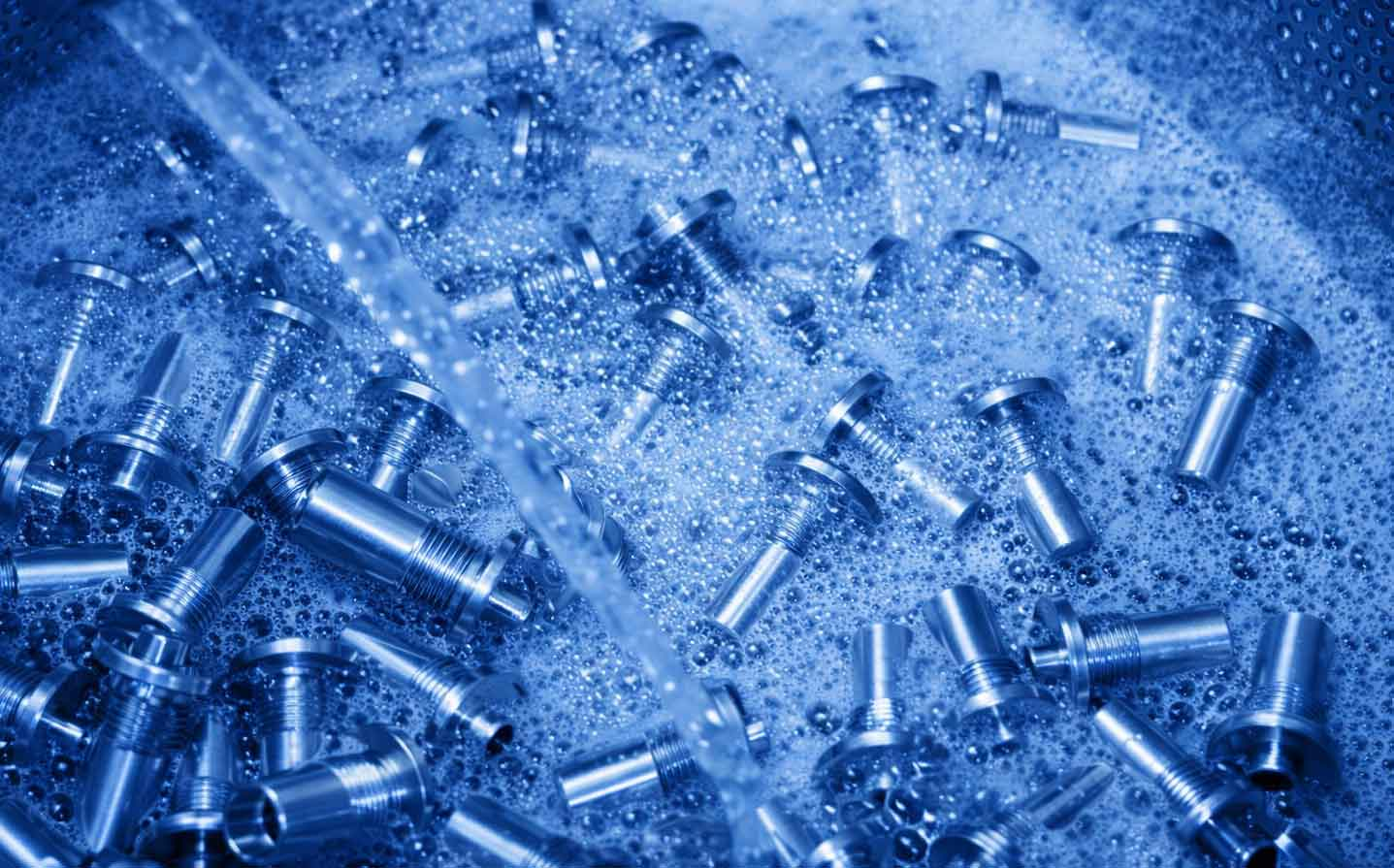
Cavitation extends cleaning action across immersed, accessible surfaces.
An ultrasonic generator supplies high-frequency electrical energy to transducers connected to a cleaning tank. The transducers create alternating pressure waves in the liquid, forming microscopic cavities that grow and collapse. This cavitation produces localized agitation that helps dislodge contamination from exposed surfaces, threads, joints, recesses, hinges, and other geometry reached by the liquid and acoustic field.
Cleaning performance depends on the component, contamination, bath chemistry, liquid level, frequency, power, temperature, time, loading, orientation, degassing, rinsing, drying, and required end condition. Ultrasonic cleaning is not automatically suitable for every material, coating, seal, adhesive, electronic assembly, blind passage, or trapped volume.
Control the variables that determine ultrasonic-cleaning performance.
The tank alone does not define the process. The part, soil, liquid, acoustic settings, loading, and release criteria work as one system.
Part Compatibility
Review base material, coatings, seals, adhesives, electronics, fragile features, and trapped-liquid risk.
Soil Identification
Define oil, grease, particulate, polishing compound, scale, process residue, oxidation, or mixed contamination.
Cleaning Chemistry
Select an approved aqueous or other compatible liquid and concentration for the part and soil.
Acoustic Variables
Establish frequency, power, tank condition, transducer performance, loading, orientation, and degassing.
Rinse & Drying
Remove loosened soil and chemistry using the required rinse quality and controlled drying method.
Verification & Release
Inspect, test, document, and protect the cleaned component against the agreed acceptance criteria.
From compatibility review to inspected release.
Cycle time cannot be responsibly stated without the part, load, soil, chemistry, acoustic settings, and cleanliness target.
Identify the part
Record materials, geometry, dimensions, quantity, condition, assembly details, and sensitive features.
Characterize the soil
Determine contamination type, thickness, access, prior cleaning, and hazardous-residue controls.
Select the bath
Choose compatible liquid, chemistry, concentration, temperature, filtration, and change criteria.
Configure the load
Arrange baskets, spacing, orientation, liquid access, degassing, frequency, power, and time.
Rinse, dry & inspect
Remove residual chemistry and soil, dry trapped areas, and perform the required verification.
Release or reprocess
Accept, repeat, change variables, use another method, or route for repair under the findings.
Information needed to determine ultrasonic-cleaning suitability.
A component may be physically immersible yet still be unsuitable because of materials, sealed cavities, electronics, or required cleanliness.
A separate validated process and acceptance method are required when the application calls for disinfection, sterilization, oxygen cleaning, high-purity cleaning, particle limits, nonvolatile residue limits, or another controlled cleanliness level.
- Part identification, complete materials, coatings, seals, adhesives, electronics, dimensions, and photographs
- Contamination type, process history, prior cleaners, hazardous residue, and desired end condition
- Accessible passages, blind holes, joints, trapped volumes, disassembly, orientation, and basket-loading needs
- Approved chemistry, temperature limits, water quality, rinse requirements, corrosion control, and drying
- Customer cleanliness limit, visual, UV, swab, particle, residue, functional, or other acceptance method
- Quantity, repeatability, downstream repair or treatment, clean packaging, documentation, and schedule
Build the complete Haygor service route.
Connect this service with related cleaning, machining, repair, calibration, coating, or assembly work when the application requires a broader scope.
Send the part, materials, soil, geometry, and required end condition.
Haygor can review compatibility, chemistry, process variables, rinsing, drying, inspection, and downstream service.