

Why Use Diaphragm Seals?
Six critical reasons to protect industrial pressure instruments
Isolate pressure gauges and transmitters from corrosion, plugging, extreme temperatures, hazardous media and contamination—without losing an accurate pressure signal.
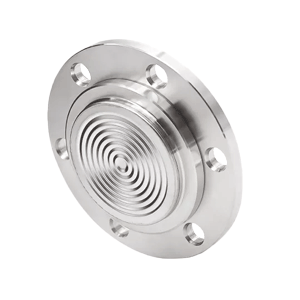 Engineered as part of the complete pressure-measurement system
The most important reason to use a diaphragm seal is process isolation. Use one whenever direct contact between the process and the instrument is likely to cause corrosion, plugging, contamination, temperature damage, unsafe exposure or unacceptable maintenance.
- Protects gauges and transmitters
- Reduces plugging and dead legs
- Supports remote instrument mounting
- Can reduce lifecycle maintenance
What is a diaphragm seal, and how does it work?
A diaphragm seal, sometimes called a chemical seal, isolates a pressure-sensing instrument from the process medium. Process pressure acts on a flexible diaphragm. A compatible fill fluid then transfers that pressure through the sealed hydraulic assembly to the pressure gauge, pressure transmitter, switch or controller.
The instrument receives the pressure signal without its sensing element directly contacting the process. That distinction is why diaphragm seals are used throughout refining, chemical processing, pulp and paper, food and beverage, wastewater, pharmaceutical and other demanding industrial applications.
The six most important reasons to use a diaphragm seal
The ranking below reflects how frequently these conditions drive diaphragm-seal selection, not necessarily their severity. Toxic or hazardous service may become the first priority immediately, even when it is less common than corrosion or plugging.
Corrosive or chemically incompatible process media
Chemical incompatibility is usually the strongest and most common reason to use a diaphragm seal. Acids, caustics, chlorine-bearing chemicals, oxidizers, solvents and sulfur-bearing streams can attack a gauge's Bourdon tube or a transmitter's sensing element.
A seal allows the process-wetted components to be selected in a compatible metal, specialty alloy, polymer or engineered coating while isolating the instrument. Every wetted part must be reviewed—including the diaphragm, lower housing, extension, process connection, gasket and flushing ring. Selecting only the diaphragm material can leave another component vulnerable.
Typical services: acids, caustics, oxidizers, chlorine service, sour or sulfur-bearing streams, aggressive solvents and incompatible process additives.
Viscous, plugging, crystallizing or solids-laden media
Heavy oils, polymers, resins, pulp stock, sludge, syrups and particulate-bearing fluids can block the small pressure passages found in conventional instrument connections. The result may be slow response, trapped pressure, false readings or complete loss of measurement.
A threaded flush diaphragm seal, a flush flanged seal, an extended diaphragm or a flow-through configuration reduces the cavities where material can collect. The right geometry matters as much as the material.
Typical services: high-viscosity fluids, suspended solids, fibrous stock, polymerizing media, crystallizing salts, wax, asphalt, slurry and processes that require frequent flushing.
High- or low-temperature process service
A diaphragm seal is often used when the process temperature exceeds the safe operating range of the gauge, transmitter or standard fill system. Cooling elements, thermal barriers or remote capillaries can separate the instrument from the process temperature.
Temperature applications require system engineering. Fill fluid expands and contracts, which can create an apparent pressure shift. At low temperature, an otherwise suitable fill may become viscous and slow the response. Diaphragm area, fill volume, capillary length, ambient exposure, instrument displacement, gasket limits and pressure rating at temperature all need review.
Typical services: steam, hot oil, reactors, heated polymers, furnaces, cryogenic liquids, large ambient-temperature swings and processes outside the instrument's direct-mount rating.
Toxic, hazardous or environmentally sensitive media
When process fluid creates a personnel, environmental or fire hazard, keeping it out of the pressure instrument becomes a safety and reliability issue. A remote seal system can also place the instrument where technicians can access it without approaching a hot or hazardous process connection.
A standard diaphragm seal should not automatically be described as secondary containment. If an application requires dual containment, leak detection or a specific fugitive-emissions classification, the assembly must be explicitly designed, tested and documented for that duty.
Typical services: toxic chemicals, flammable hydrocarbons, hydrogen-rich processes, corrosive gases and difficult-to-access process nozzles.
Sanitary and high-purity processes
In hygienic service, the seal protects the process from the instrument as well as the instrument from the process. A flush, cleanable diaphragm helps prevent product from collecting in threaded passages, recesses and dead legs.
A sanitary clamp alone does not make a complete measuring system sanitary. Connection type, diaphragm material, surface finish, gasket, drainability, crevice-free geometry, fill fluid and CIP or SIP temperature all have to satisfy the applicable hygienic requirement. Review Haygor's sanitary diaphragm seal configurations for cleanable process connections.
Typical services: food and beverage piping, pharmaceutical vessels, fermentation, high-purity water and clean-in-place or sterilize-in-place systems.
Abrasive or erosive media
Slurries and particle-bearing fluids can erode small instrument passages or damage the sensing element. A diaphragm seal places an application-specific, replaceable wetted barrier between the abrasive process and the instrument.
The diaphragm remains exposed, so abrasion has not disappeared. Material, thickness, geometry, location, particle hardness and process velocity determine service life. Severe slurry applications may perform better with an in-line saddle seal, flow-through seal or isolation-ring arrangement rather than a small conventional seal.
Typical services: mineral slurry, catalyst fines, fly ash, sand-bearing water, drilling fluids and wastewater containing grit.
Match the process problem to the seal approach
| Process condition | Risk to the measurement | Typical design direction |
|---|---|---|
| Corrosive chemical | Material attack, leakage, calibration instability | Compatible diaphragm, body, gasket and process connection |
| Viscous or plugging media | Blocked passages, slow response, trapped pressure | Flush, extended, flow-through or pulp-and-paper geometry |
| High or low temperature | Instrument damage, fill expansion, slow cold response | Cooling element, remote capillary, suitable fill or thermal barrier |
| Hazardous process | Technician exposure and difficult maintenance access | Remote mounting and application-specific containment review |
| Sanitary process | Product accumulation, contamination and poor cleanability | Flush sanitary connection, suitable finish, gasket and fill |
| Abrasive slurry | Erosion of passages, diaphragm or sensing element | Robust material and geometry positioned to reduce direct impact |
A diaphragm seal protects the instrument, but it can affect the measurement
A seal is not a passive adapter. The diaphragm, fill fluid, attachment, capillary and sensing element form one hydraulic measurement system. The goal is to obtain the necessary process isolation without degrading accuracy, sensitivity or response beyond the application's tolerance.
Working pressure is not minimum usable span
A seal may safely contain high pressure and still be unsuitable for a very low calibrated span. Low ranges normally require a sufficiently large, compliant diaphragm and controlled system volume.
Longer capillary is not automatically better
Extra capillary adds fill volume, hydrostatic head, ambient-temperature exposure and potential response delay. Use the shortest practical length that supports safe installation and maintenance.
Fill fluid needs a complete temperature review
Maximum temperature is only one criterion. Minimum temperature, viscosity, thermal expansion, vapor pressure, vacuum suitability, specific gravity and critical-service requirements also matter.
The assembly must be calibrated as a system
The instrument, seal, capillary and fill should be evacuated, filled, leak-tested and calibrated together. Opening a filled capillary changes the hydraulic system.
Three diaphragm-seal problems solved in different ways
These examples distinguish a published customer field case from Haygor engineering validation and application examples. That distinction matters: a successful field result should not be presented as a universal performance guarantee.
Hydrochloric-acid service at a Gulf Coast chemical processor
Conventional stainless-steel diaphragm seals faced pitting and corrosion in hydrochloric-acid service. Haygor supplied an application-specific fluoropolymer- coated wetted design. Haygor reports that after six months of continuous operation, inspection found no pitting or corrosion, calibration remained stable and the maintenance interval increased by more than 50%.
The exact PTFE/Teflon construction should be confirmed for each new application; it should not be assumed to be the legacy non-stick-only coating option.
Read the Haygor-reported corrosion caseUltra-high-temperature pressure measurement
Haygor developed Thermal Guardian® with an oil-free liquid-metal fill and heat-dissipating thermal-barrier structure. Haygor reports a 48-hour test with a constant 1,280°F process-side temperature on a 2.4-inch standard diaphragm at 75°F ambient, producing an approximately 800°F temperature drop across the structure.
Haygor specifies the system for continuous process exposure up to 1,200°F, subject to review of the complete seal, instrument, materials, pressure and installation. The 1,280°F value is a test condition, not the continuous-service rating.
DP tank-level drift caused by weather
Sunlight and changing ambient temperature can heat high- and low-side capillaries differently. Unequal fill-fluid expansion then creates false differential pressure and apparent level movement. Haygor's Temperature Compensating Remote Seal System uses additional compensating capillaries whose thermal effects oppose the imbalance in the measurement capillaries.
Review the temperature-compensating remote seal conceptWhen is a diaphragm seal unnecessary?
A diaphragm seal should not be added automatically. Direct connection is usually simpler when the process is clean, non-plugging, chemically compatible with the instrument, within its temperature limits and safe for technicians to access.
The best seal is not the most rugged seal. It is the seal that provides the required process protection without degrading the measurement beyond the application's tolerance.
Information needed to select a diaphragm seal correctly
A reliable selection begins with the complete process and installation data. Omitting one condition can change the diaphragm size, material, fill fluid, capillary or mounting recommendation.
- Process fluid, concentration and contaminants
- Normal, startup, shutdown and upset temperatures
- Process and ambient minimum and maximum temperatures
- Working pressure, calibrated span and pressure spikes
- Vacuum or minimum absolute-pressure condition
- Instrument manufacturer, model and exact calibrated range
- Required response time and control-loop function
- Process connection, rating, facing and gasket requirements
- Transmitter elevation and capillary route or length
- Cleaning, sanitary, oxygen, chlorine or other critical-service requirements
Why Haygor treats a diaphragm seal as an engineered assembly
Haygor's principal distinction is its system-level approach. The seal, fill fluid, capillary and pressure instrument are evaluated as one hydraulic measuring system, with support across major gauge and transmitter brands.
In-house manufacturing, filling and testing
Haygor combines machining, welding and fabrication with vacuum filling, testing and calibration services for the completed assembly.
Repair, rebuild and retrofit capability
Haygor can repair or remanufacture filled systems, replace diaphragms and capillaries, and build custom components for older or difficult-to-source assemblies.
Application-specific materials and geometry
Standard and custom constructions can address chemical compatibility, sanitary service, hydrogen permeation, high temperature, plugging and unusual process connections.
Maintainability designed into the assembly
Features such as a calibration or flushing ring can support venting, flushing and verification without dismantling the seal.
Diaphragm seal FAQ
What is the main purpose of a diaphragm seal?
Its main purpose is to keep difficult process media away from a pressure gauge, transmitter, switch or controller while transmitting process pressure hydraulically to the instrument.
When should a diaphragm seal be used?
Use one when direct process contact is likely to cause corrosion, plugging, contamination, temperature damage, unsafe technician exposure, excessive maintenance or premature instrument failure.
Does a diaphragm seal improve pressure instrument accuracy?
Not automatically. The seal protects the instrument, but the full hydraulic system must be engineered so temperature effects, head pressure and response time remain within the required measurement tolerance.
Can diaphragm seals be used for high-temperature processes?
Yes. Depending on the application, the system may use a cooling element, remote capillary, suitable fill fluid or application-specific thermal barrier. Every component and the complete temperature envelope still require review.
Which media commonly require a flush diaphragm seal?
Flush diaphragm seals are commonly used with viscous, crystallizing, polymerizing, fibrous, slurry and solids-laden media that can plug a conventional small-bore pressure connection.
Can a filled capillary be cut or shortened in the field?
No. It is part of a sealed hydraulic system. Cutting or opening it compromises the fill and requires proper evacuation, refilling, leak testing and recalibration.
Can an existing diaphragm-seal assembly be repaired?
Often, yes. Repair or remanufacture may be practical when the process connection and core configuration remain suitable. The failure cause should be diagnosed before rebuilding so the same process problem is not repeated.
Specify the complete diaphragm-seal system before it reaches the field
Have a corrosive, plugging, high-temperature, sanitary or otherwise difficult pressure application? Complete Haygor's Diaphragm Seal Specification / Quote Request form. Haygor can evaluate the instrument, process conditions, wetted materials, fill fluid, mounting and capillary configuration before recommending a standard, custom or repair solution.
Urgent or unusual application? 713-641-1791 sales@haygor.com
Application examples and published performance values are application-specific and are not universal service-life or performance guarantees. Final material, pressure, temperature, fill-fluid and installation suitability must be confirmed for the complete assembly.